











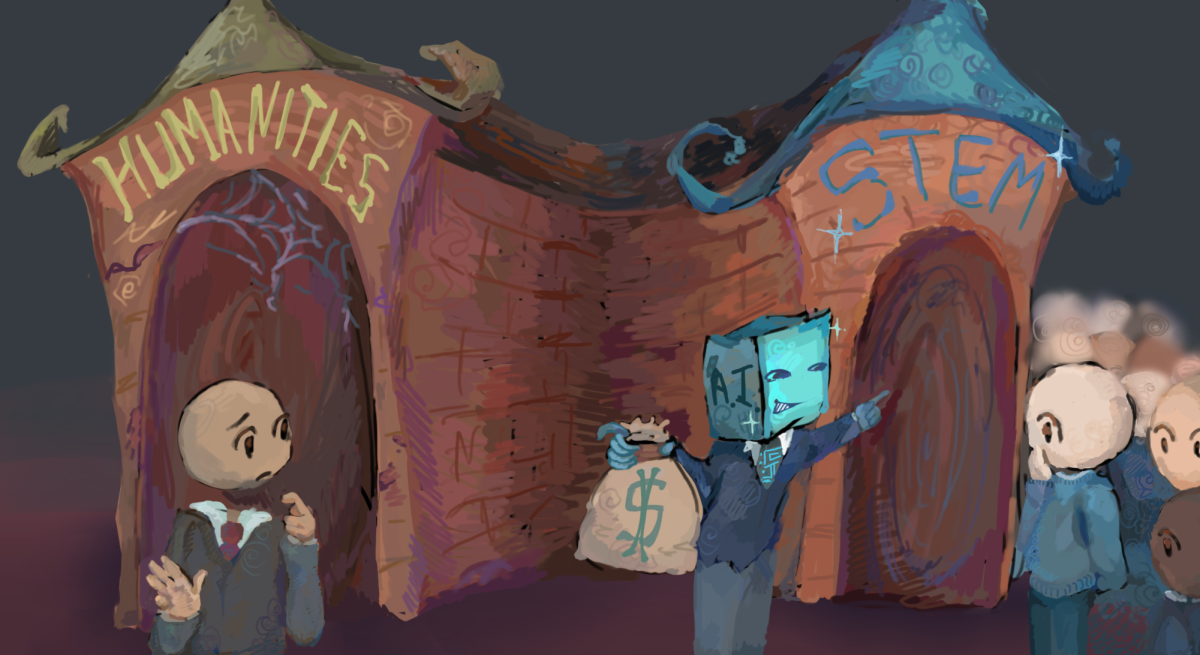












It’s no secret that we are entering a new rise and domination in the technological industries with the emerging development of AI. This has led many to question what impact this is having on other parts of our society and our daily life. With this new technology to process and find new information at record speeds, it seems that some jobs are being pushed aside–specifically, those that do not follow at the heels of these innovative shockwaves. Due to this and other factors such as our continued emphasis on teaching STEM classes in high schools, it seems, we are witnessing the death of the humanities.
First, let’s take a closer look at what the humanities are, and their impact on society. When referring to the humanities, there’s a vast tide of different majors ranging from philosophy and art history, to the more well-known majors of literature, history, and politics. These majors serve as the backbone to many different aspects of society with their focus on the historical and linguistic skills. These essential subjects are an important aspect in society, leading us to have teachers, historians, and government officers–careers that fulfill a necessary and dutiful part of the workforce. Yet, in recent years, there has been a pull away from these careers, with a decline of 4.3% of all degrees that are humanities based. This percentage may seem low, but in 1971, 17.1% of degrees were humanities degrees. In 2021 it dropped to 12.8 % (The Tufts Daily), meaning that of that 17.1%, there was a 25.2% overall decrease in humanities degrees. We have lost almost a quarter of the humanities majors in 40 years.
With the decline in people’s choice to follow the humanities, a natural question is why? In recent years you may have seen articles detailing the most regretted, or useless degrees people have earned after graduating college. This list largely consists of humanities degrees, like journalism, or government policy. These articles highlight how most of these degrees come with financial uncertainty and the inability to pay your bills (CNBC). So, a factor that is leading towards the death of the humanities is a declining market, straying away from these skills, steering many to looking for higher earning jobs. According to Georgetown research, it was found that arts and humanities majors made on average $69,000 per year. In contrast, STEM majors had an annual salary of $98,000. This gap of $29,000 can steer many people to choose their career in STEM.
Another consideration for this dropoff is public perception. This era is marked by AI and emerging technologies. As a result, people choose to devote themselves to what is of the times instead of learning something that is perceived as less practical.
Many now have to ask themselves how they can survive and adapt to AI’s ever growing pull. Take for example journalists. In this new age, journalists have to find a balance between using it as a tool but still maintaining public trust. Now, more than ever, public perception of journalism and news sources has been greatly diminished with trust in videos and articles being found unreliable or easily dismissed as biased. The school system as a whole has also taken a hit with students and teachers trying to navigate the allure of AI. Regardless of the industry, AI has changed everything.
With the decline of humanities majors however, we lose parts of ourselves and who we have the potential to become. We will lose the endless stories from authors to come, those that can warn us of a similar plight taken through history, or even those that can help us try to become better, more moral beings. If the decline continues and the humanities dwindle, there will be a notable societal gap. We will become broken people. The humanities bring out both the special aspects of being human, but also the faults that come with it. By taking away the humanities we take away what makes us human.